Jasperland
About Archive Photos Also on Micro.blog
  • Zoom Zoom

    To whoever designed the automated zooming in and out feature on certain Apple videoconferencing products, I do whatever the opposite of tipping one’s cap is. I thumb my nose!

    Recently, several of my colleagues have been plagued by this deeply unserious feature, and so far they can’t figure out how to turn off. Now their little window on our Zoom meetings features a deranged cameraman who does things like zoom in for a tight shot right as they blow their nose, then zoom back out. The unsteady, by turns tentative and overactive camerawork has the energy of a teenager holding a camcorder, or a mockumentary (think The Office or Telemarketers). What maniac in Apple corporate thought it was a good idea to turn this feature on (with no easily found off switch!) on millions of work computers!?

    → 4:42 PM, Dec 10
    Also on Bluesky
  • A diagram on a thermometer showing chunky icons next to different labes: "Loss of Tissue Contact," "Broken Probe," "Instrument Malfunction," "Oral," "Adult Axillary (>18 yrs.)," "Rectal" "Pediatric Axillary (<17 yrs)," "Monitor Mode," and "Low Battery," with the words below, "ANTI_THEFT SYSTEM / MAY BE ACTIVE"

    To whoever designed this institutional thermometer’s legend, I tip my cap. That butt! That snail! That crawling child!!!

    → 4:41 PM, Dec 10
    Also on Bluesky
  • The Melt Report

    A photograph of a snowman standing on a stump

    Over the weekend there was a snowstorm in Chicago—eight inches! This delayed our flight home by a day, and it also gave me the chance to make my first-ever snowman! (With, admittedly, help from my kid and his mom.) There’s something so satisfying about making a sculpture out of precipitation, and dressing it up.

    Even better: getting daily melt reports from our hosts. So far not only has our snowman not melted at all, he’s actually gained a bit of snow!

    A photograph of the same snowman, now dusted with snow so that one eye is hidden.
    → 3:08 PM, Dec 3
    Also on Bluesky
  • An Intercepted Signal

    Bourgeois confession: I bought an Apple TV, one of those little streaming boxes that plugs into your TV. It came on Monday. (Part of getting older under capitalism is you have less time to do things like watch movies or make music but you compensate by spending money on better tools for these activities you no longer do much of.)

    I don’t yet have a full opinion on the little box, but I did have a thrilling experience with it: I figured out how to program the volume buttons to go directly to my stereo. It turns out the way you do this is by holding up the stereo’s remote near the Apple TV remote, then pressing the stereo remote’s volume switches as cued by the Apple TV software. The Apple TV magically intercepts the signal, learns it, and now can reproduce it. Yes!

    → 3:07 PM, Dec 3
    Also on Bluesky
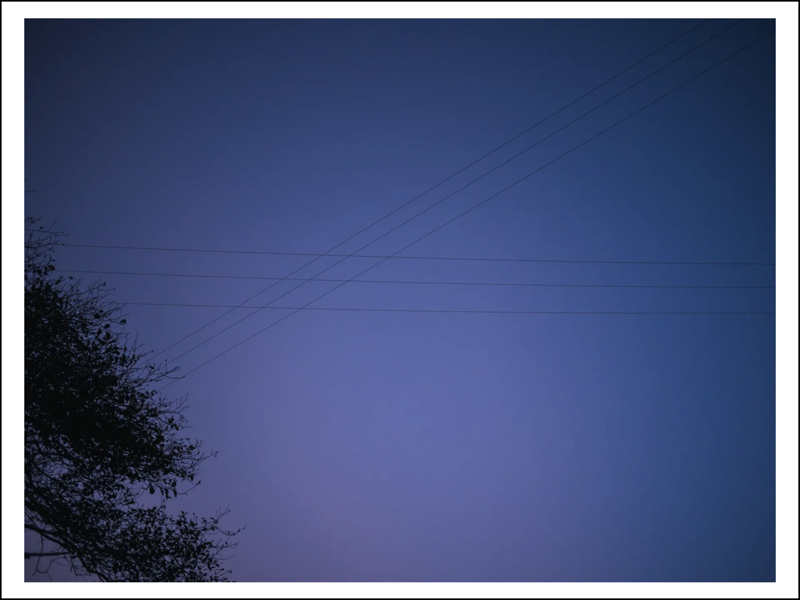
  • A photograph of power lines crossing against a dim blue sky, with silhouetted branches in the lower left corner
    → 3:07 PM, Dec 3
    Also on Bluesky
  • To Avoid Having to Experience the Experience

    During our trip to Chicago, we splurged on “high tea” at the Drake Hotel. It was ridiculous and fun. The best part was that for the first half of the meal there was a harpist playing, and then for the second half there were three professional carolers roaming the dining room, singing a tune for each table. (For us, Lisa requested “God Rest Ye Merry Gentlemen.”)

    I noticed a sad trend, though: at many (most?) tables, when the carolers got to them, the diners each lifted their phones up to record videos. The carolers were maybe five feet away, and the phone seemed clutched like a shield, a tool to distance oneself from the intensity of being sung to, a way to get out of having to be present, to avoid having to experience the experience.

    → 3:06 PM, Dec 3
    Also on Bluesky
  • For the Love of Slop

    Because I myself am left ice cold by the “AI art” being shoved in our faces today, I was probably the perfect audience for this brief essay, “Alchemy,” by John Collinsworth. What a great metaphor, invoking just how stupid the literal attempt to turn lead to gold was. I especially appreciated this part:

    The existence of the work itself is only part of the point, and materializing an image out of thin air misses the point of art, in very much the same way that putting a football into a Waymo to drive it up and down the street for a few hours would be entirely missing the point of sports.

    The struggle that produced the art—the human who felt it, processed it, and formed it into this unique shape in the way only they could—is integral to the art itself.

    The human behind it, and their story, is the missing, inimitable component that AI cannot reproduce.

    I personally agree with this, but with the (big) caveat that all available evidence suggests that a whole lot of people don’t actually care about filling their lives with art. So many folks seem more than happy with different varieties of muzak providing a soothing background track to their lives.

    Today we have muzak on the music streamers (see “ghost artists”) but also increasingly on the video streamers (I loved this Will Tavlin piece in N+1 about today’s Netflix) and even in novels (the Write a Book a Month Club—yikes).

    Some people really like their AI slop! But art it ain’t.

    → 3:05 PM, Dec 3
    Also on Bluesky
  • The President Comes to Hollywood

    Last-minute notice here, but if you’re in LA and don’t have Friday night plans you should come out to the book party for Xander Beattie’s new-ish book The President (which you may remember from the gift guide above). It sounds like it will be an intimate party, with drinks, a reading, a conversation, and hopefully some good conversation. RSVP here to get the details. (I believe that today is the last day to RSVP.)

    → 3:04 PM, Dec 3
    Also on Bluesky
  • Related: a skit titled “We’re the New York Times!”

    → 3:03 PM, Dec 3
    Also on Bluesky
  • Sanewashing Orthobros in the NYT

    Fascinating article on an upswing in interest in Orthodox Christianity in the New York Times: “Orthodox Church Pews Are Overflowing With Converts.” And also—as with so many pieces in the Times—it’s really rather strangely edited.

    As someone who has been drawn to the more mystical edges of this faith tradition (icon worship, the Jesus Prayer), I wanted to be excited about this. I mean, come on, give me more about the iconostasis! So it first struck me as weird how the article keeps bringing up how Orthodoxy is more “masculine” than Catholicism or Protestantism. Under a photograph of a 20-year-old convert with a pretty face, braces, and perfect eyebrows there is the caption, “’Protestant and Catholic churches have a very feminine atmosphere,’ said Josh Elkins, center.” Then, a little later, this graf:

    Some converts report approvingly that Orthodoxy has a more masculine feel than other traditions. Priests, who must be male and can marry, often have large beards and big families. Orthodoxy asks practitioners to make sacrifices like fasting, rather than offering them emotional contemporary music and therapeutic sermons, which critics describe as the typical evangelical megachurch experience.

    Ah yes, fasting, something Catholicism never thought of. And what is this term, “emotional contemporary music”? The writer must mean Christian rock music? If the author’s sources stopped and thought for a second, they’d realize that the idea that Orthodox choral music is free of emotion—or even particularly straight-coded—is risible. Just check out this recording from a St. Petersburg church that I randomly ran into last week.

    The praise for a “masculine” religion and the dissing of other faiths as not being hard enough is all hedged through this language of “some converts report approvingly…” and “which critics describe as…” It’s only in the final third of the article when the reporter finally gets to give up the act and tell us who these critics are: gleefully fascist, openly antisemitic, hyper-patriarchal YouTube influencers! (“Orthobros”)

    Here’s the first stab at defining these guys, 1800 words in:

    The online influencers that many young men credit with introducing them to Orthodoxy speak directly about politics and culture in a way that parish priests more often avoid. They tend to share an unbending social conservatism, with a particular interest in the “traditional family” and what they describe as the threats of feminism, homosexuality and transgender identities. They are also generally opposed to the state of Israel.

    Then, 246 words later, they come further into focus:

    In the South, there is a strain of neoconfederate Orthodoxy that marries white supremacy and Orthodox practice. Matthew Heimbach, who organized the notorious Unite the Right rally in Charlottesville, Va., in 2017, had been excommunicated from the Antiochian Orthodox church but joined another branch.

    And finally, at the very end of the article, we get a portrait of a couple who are currently converting:

    But the couple agreed that too many mainstream Protestant churches offered only shallow theology and “far-left” ideology. Ms. Fuentes’s former church had a female pastor, which she said she didn’t approve of, and she said she once saw a transgender woman, whom she described as a man, in the women’s bathroom there during a Christmas service.

    “There’s just more validity in a church that can trace its lineage all the way back to the apostles,” Mr. Nolan said.

    The couple said they were looking forward to raising an Orthodox family, one oriented around duty, truth and “objective beauty standards,” Mr. Nolan said. In their future home, they are planning a prayer area facing east.

    Well, at least we got there. What a bummer.

    → 3:02 PM, Nov 27
  • A photo of a dusky sky silhouetted by dark palm trees and other foliage
    → 3:00 PM, Nov 27
  • Understanding Epstein

    It’s darkly funny to me that the “Epstein Files” stunt from this spring was such a nothing-burger, but the actual Epstein emails released last week are, in fact, jam-packed with scandal and the dirty laundry of power. I’ve looked on with horror as we’ve learned of subplots like the unbearable creepiness of Larry Summers and figuring out who is Bubba? (It’s pretty clear…) But I think there’s both so much here, and our newspapers are so depleted, that it’s hard to find good explanations of the bigger picture. So I appreciated this episode of the Time of Monsters podcast, “Jeffrey Epstein and the American Empire.” Here’s guest Van Jackson laying out how he sees Epstein fitting into the broader American political scene:

    Epstein is the embodiment of power politics in neoliberal globalization. And that happens to be very corrupt at its core. So this thing that we called “the International Global Order”—in Washington there’s a romantic gloss on what that was—but what that really was was agents like Epstein profiteering from world affairs and helping consolidate state control of societies. So American hegemony imposed a kind of imperialist peace on the world, especially in Asia. And that imperialist peace was basically peace for rulers but imperialism for the ruled. American hegemony secured ruling class solidarity, basically, but against working class interests.

    Chaser: “How the Elite Behave When No One Is Watching: Inside the Epstein Emails.”

    → 2:59 PM, Nov 27
  • Mummy Brown and Rudyard Kipling

    Elias submits a truly delightful (and by turns stomach-turning) expansion on last week’s mote about the artistic use of mummies: an entire scholarly article on the subject, titled “The Life and Death of Mummy Brown.” This article has it all, including the etymology of “mummy,” the history of “mummy unrollings,” and even a surprise appearance from Rudyard Kipling at an impromptu pre-Raphaelite burial of a tube of mummy brown:

    This bizarre but rather touching episode must have had quite an impact on those present, including a teenaged Rudyard Kipling, who was Georgina’s nephew. Kipling used to spend every December with the Burne-Jones’ at their London home. Here is how he described the mummy episode some decades later: “He [Burne-Jones] descended in broad daylight with a tube of ‘Mummy Brown’ in his hand, saying that he had discovered it was made of dead Pharaohs and we must bury it accordingly. So we all went out and helped – according to the rites of Mizraim and Memphis, I hope – and to this day I could drive a spade within a foot of where that tube lies.”

    → 2:58 PM, Nov 27
    Also on Bluesky
  • A photo of a pink rose
    → 2:57 PM, Nov 27
  • Stark Moral Clarity

    This time of year always feels hard to me, for a bunch of reasons. But one is that the cold weather is really hard on our unhoused neighbors, people sleeping rough—and it feels so wrong to eat, drink, and be merry when someone nearby is suffering, often terribly suffering.

    But do I do much about it?

    I felt chastened by the stark moral clarity in the latest essay from Adam Wilson. Wilson runs a farm where he gives everything away. (I found out about him via this beautiful twenty-minute documentary.) His newsletter is like a letter from a saint, or an extreme altruist, or a man from another time. In his latest issue—“The Normalization of Non-Sharing”—he talks about his first visit to a restaurant since the pandemic:

    I haven’t been to a restaurant in years. But I decided to push myself this time, given the shortness of the visit and the family’s wishes. I wasn’t going to order food, but at least I could join in the conversation and try not to be too much of a grump for a couple of hours—two aims at which I didn’t succeed. But grumpy isn’t really an accurate word for the sorrow that washes over me when I try to find a comfortable seat at a table founded upon the polite normalization of non-sharing.

    In order to build and maintain the specific form of household we call a market economy, all of its residents must internalize the notion that they are only worthy of eating and staying warm if they contribute to the household maintenance in one most fundamental way: making money. Failure to do that is a punishable offense.

    Thus, on the cold, damp day that I decided to break my no-restaurant rule, all of the local people without money kindly kept up their end of the bargain and stayed away. Those with money looked at menus, used the toilet, washed their hands, and warmed themselves by the fireplace. In order to continue functioning, the market economy requires everyone to play their parts. A flood of snow-soaked street people would have made quite a stir in the polite atmosphere of the restaurant. Likely, the police would have eventually been called. In this household, overt or stubborn insistence upon neighborly sharing can become a punishable offense.

    I appreciate being reminded of the choice we collectively make to keep running things the way we do. As Ursula K. Le Guin said, “We live in capitalism, its power seems inescapable — but then, so did the divine right of kings. Any human power can be resisted and changed by human beings.”

    → 2:57 PM, Nov 27
  • An artsy photo of a sportscar front bumper that has been sanded.
    → 2:54 PM, Nov 27
  • → 10:24 AM, Nov 19
    Also on Bluesky
  • This GxAce video, “I Visited a Camera Lens Factory and Saw Something I Didn’t Expect” seems clearly to be a piece of sponcon. It’s also a sweet prose poem—a paean to the workers who actually make the lenses ostensibly being reviewed. An interesting artifact, beautifully made.

    → 10:24 AM, Nov 19
    Also on Bluesky
  • I hope they find Mango!

    → 10:23 AM, Nov 19
    Also on Bluesky
  • One Leo After Another

    I enjoyed the latest Paul Thomas Anderson flick, One Battle After Another, as a piece of entertainment. But I found myself a bit skeptical of its political message, inasmuch as it even had a coherent politics. So I was glad to read this scathing review by Jason England in Defector. I don’t know if I agree with everything in it, but I love a good no-punch-pulled argument against anything suspiciously popular. A sample:

    Because of the messiness of the racial politics, One Battle After Another functions as a hybrid of Rorschach test and rage bait, providing heavy-handed symbols of contemporary social and political ideologies, with nebulous insights underpinning them, while also providing ammunition for the insufferable intraracial gender wars.

    It helps explain what I found missing.

    → 10:22 AM, Nov 19
    Also on Bluesky
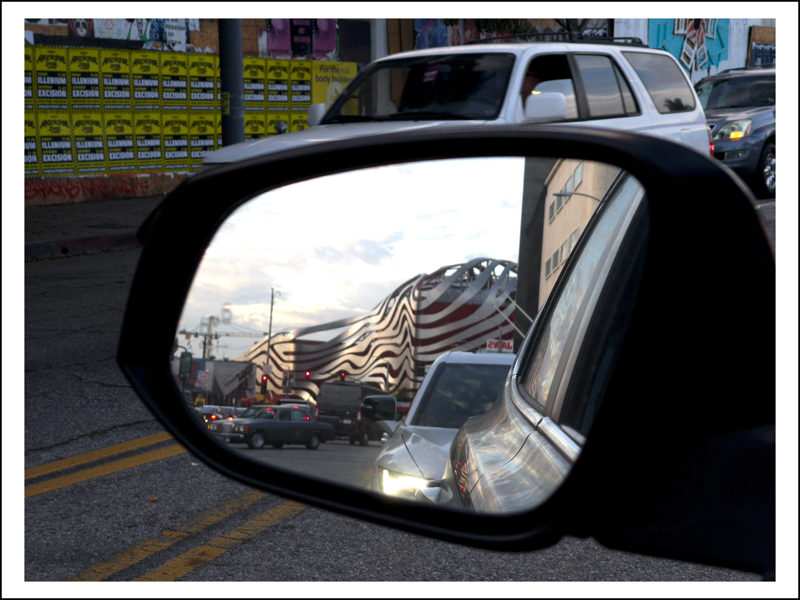
  • A photograph of a car's rear view mirror with a strange building in the reflections.
    → 10:21 AM, Nov 19
    Also on Bluesky
  • Michael Jackson, Shaman

    High recommend for the Weird Studies interview with Shannon Taggart where she discusses her investigation into the liminality and spectral persistence of Michael Jackson. I generally love Weird Studies, and this episode is a standout. Here’s Taggart on the strangely shamanic quality of Jackson’s sleep:

    Part of my major thesis is that his themes are transformation and change—and that the control of the dream state, I propose, was possibly the reason he died in such a strange way. So he died of acute propofol intoxication in 2009, and he had not had REM sleep in 60 days. A Harvard doctor testified that he is the only documented example of a human being having such an extreme sleep deprivation. Because propofol does not put you to sleep, it makes you enter a coma-like state. So I found this quote of Michael saying to Deepak Chopra, he asked, ‘Deepak, have you heard of this thing that takes you to the Valley of Death and then brings you back?’ He was obviously talking about this anesthetic. So I proposed that part of his death was to gain inspiration.

    → 10:21 AM, Nov 19
    Also on Bluesky
  • Ground Up Ancient Egyptians

    Did you know that mummy brown was one of the favorite paints of the Pre-Raphaelites? Next time you gaze on one of their horny, numinous canvases, just think of how this “rich brown bituminous pigment with good transparency, sitting between burnt umber and raw umber in tint” was “made from the flesh of mummies mixed with white pitch and myrrh.” It only went out of style when “fresh supplies of mummies diminished,” and even then it continued being sold into the mid-20th-century.

    I sometimes wonder if there’s a parallel between how 18th and 19th century aristocrats treated mummies (see: mummia) and the cavalier but also quasi-religious way that our elites treat the flammable fluid fossils known as petroleum.

    → 10:20 AM, Nov 19
    Also on Bluesky
  • If you have some leftover pie, why not cut it up into big chunks and eat it with your hands?

    → 10:23 PM, Nov 12
    Also on Bluesky
  • A Crime Against Color

    The latest from Animation Obsessive, “The ‘Toy Story’ You Remember,” seems potentially abstract and technical: it’s about how in the early days of digital animation, films still had to be transferred onto 35mm prints to be distributed to theaters, which perversely means that the currently available digital prints of these movies (Toy Story, A Bug’s Life, The Lion King, Aladdin) are showing different colors than the original release. But the side-by-side comparisons are truly shocking.

    Ca25faad c263 42fd b261 3e9b4e3197ba_1892x2122.jpg.

    (That’s the 35mm Aladdin print on top and the current streaming version below.)

    As a child of the ’90s, these films are canon. It’s crazy to realize how much they’ve changed.

    → 10:23 PM, Nov 12
    Also on Bluesky
← Newer Posts Page 4 of 24 Older Posts →
  • RSS
  • JSON Feed